Samyoung Sunhwa,
together with Innobase, built an integrated control system to monitor emergency situations in real time across all of its sites, while smartening equipment inspections — strengthening a safe and efficient smart factory system.
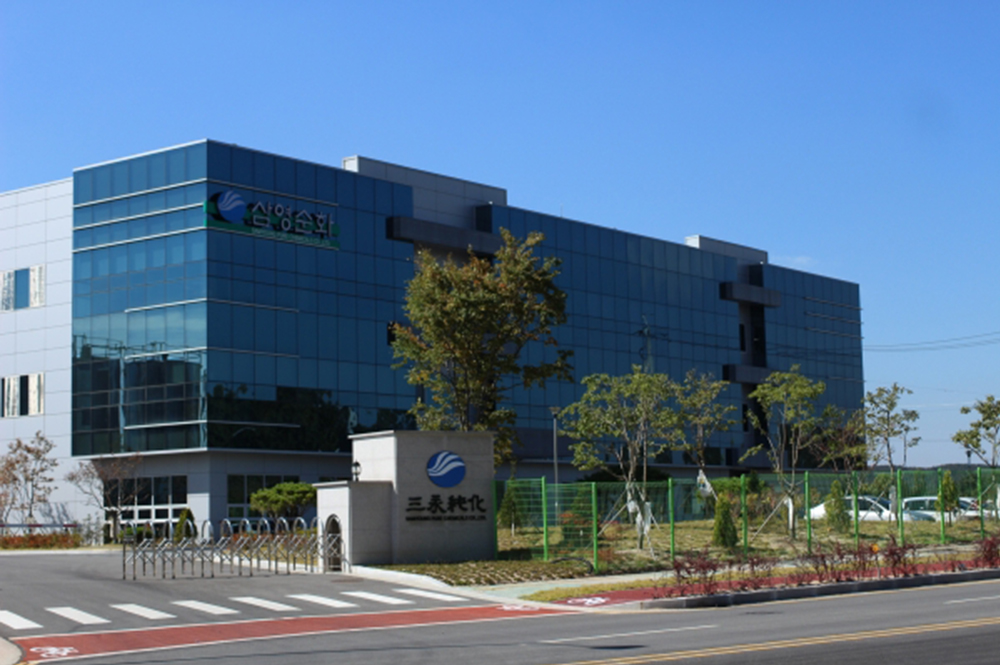

Samyoung Sunhwa is a fine chemicals company that manufactures and sells ultra-high-purity and high-performance chemicals essential to producing core components for the electronics industry, including semiconductors, displays (OLED and LCD), solar cells, and PCBs. Founded in 1989, Samyoung Sunhwa has grown alongside Korea's semiconductor industry as a joint venture between Mitsubishi Gas Chemical (MGC) of Japan — which has held proprietary hydrogen peroxide manufacturing know-how and ultra-high-purity hydrogen peroxide production capability for semiconductor use since the 1930s — and Hansol Chemical, Korea's leading hydrogen peroxide specialist. As a dedicated manufacturer of ultra-high-purity hydrogen peroxide, the company has contributed to the advancement of the semiconductor industry. With technical support from Mitsubishi Gas Chemical, Samyoung Sunhwa also manufactures and supplies high-quality, high-performance chemicals — including various etchants, strippers, cleaners, dry film strippers, and developers — used in semiconductors, LCDs, OLEDs, solar cells, and PCBs, contributing to the growth of the electronics industry.
As a specialized supplier of functional chemicals for the semiconductor and advanced electronics industries, Samyoung Sunhwa handles hazardous chemical substances — making the management of on-site emergencies critically important, alongside equipment inspection processes that prevent human error and improve operational efficiency. Fire detectors, leak sensors, and gas detectors had already been installed on key equipment throughout the company's sites, but when a sensor was triggered, its location could only be identified at the control panel — delaying emergency response and creating a high risk that damage could escalate exponentially. Occasional false alarms also led to operational losses.
In addition, the water levels of wastewater discharge/collection tanks and industrial water ponds could not be monitored in real time, requiring control room staff to visit each site in person and check levels visually — creating a significant risk of environmental incidents from tank overflows, or of production delays from industrial water shortages. On-site equipment was also inspected daily, weekly, and monthly using paper checklists, raising the risk of human error such as missed inspection items, and this analog inspection method resulted in wasted manpower and resources, while the resulting data went largely unused.
Samyoung Sunhwa's goal was to build a safer workplace and reduce operational losses by centrally managing the detectors and sensors located across its sites, and to digitize equipment inspection records and data company-wide — while reducing the cost and time previously required to manage them.
Samyoung Sunhwa needed integrated control across all of its sites, both for safety and for efficiency. Existing detectors occasionally triggered false alarms, and locating a triggered sensor took time, which in turn delayed the response. To address this, Innobase linked the data from all fire detectors, leak sensors, gas detectors, and their PLC/control panels into a single monitoring system, allowing control room staff to oversee every site through one dashboard — monitoring emergencies in real time and enabling a rapid response. The same integrated control system was also applied to water-level sensors, displaying real-time water levels for wastewater collection and discharge tanks and industrial water ponds and triggering advance warning alarms when a tank neared overflow or the industrial water level dropped too low — all without requiring an on-site visual check.
Alongside the integrated control system, Innobase digitized equipment inspections that had previously been performed daily, weekly, and monthly using paper checklists and kept as physical records. Under the previous process, inspectors used a paper checklist for each piece of equipment and recorded results by hand; Innobase instead generated and attached a QR code to every piece of equipment, so that scanning the code automatically uploads the inspection and its results, which can then be viewed through the integrated control system. Inspectors can now attach photos when uploading results, overcoming the limits of handwritten records, and inspection cycles can be configured in the system so that staff are automatically alerted by company email, text message, or KakaoTalk when an inspection is due, rather than having to track the schedule themselves. If an inspection turns up an abnormality, an alert is immediately sent to the designated personnel. All of these automated inspection records are converted into data and accumulated for future analysis and use.
Samyoung Sunhwa is a specialized functional chemicals provider for the semiconductor and advanced electronics industries, and a leader in precision electronic chemical technology. As semiconductor manufacturing technology advances at a remarkable pace, the chemicals used in the process are required to reach ever-higher purity levels with minimal impurities — and Samyoung Sunhwa continues to do its utmost to meet that demand.
Innobase, in turn, drew on its extensive know-how and expertise to build the optimal solution for improving on-site operations and efficiency at Samyoung Sunhwa, a company committed to continuous product development and improvement in delivering world-class products. As a result, the integrated control system cut emergency response times by 90%, while the smart-device-based equipment inspection system reduced inspection time by 72%. This naturally reduced the manpower required for inspections as well, successfully creating a safer workplace and a more efficient working environment.
 Blog
 YouTube

 Naver TV
 Naver Clip